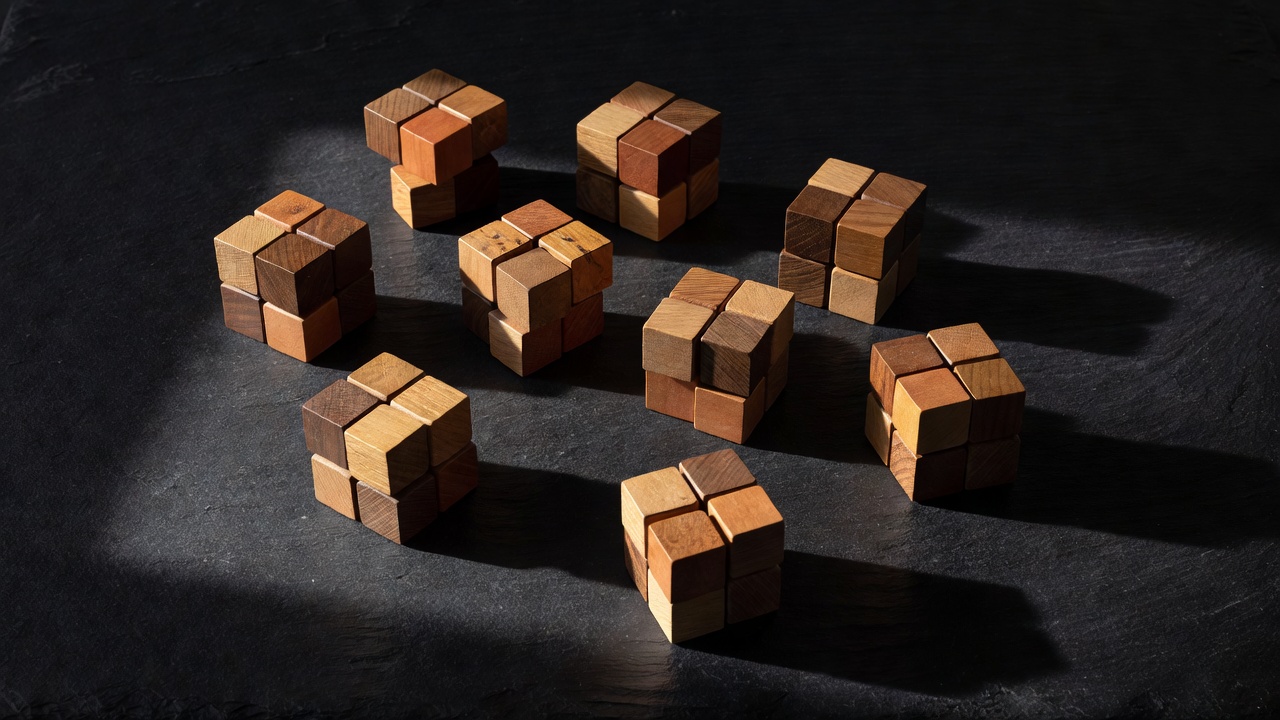
Start with something small
Begin with a single wooden cube cut into seven parts. The Danish polymath Piet Hein is credited with conceiving the Soma cube in 1933, reportedly while listening to a lecture on quantum mechanics by Werner Heisenberg. The idea was simple: take every irregular shape that can be formed from three or four unit cubes joined face to face. There are exactly seven, and together they contain 27 cubes — enough for a 3×3×3 block.
The puzzle became widely known outside Denmark after Martin Gardner wrote about it in Scientific American in 1958. Mathematicians John Conway and Richard Guy later confirmed 240 distinct solutions, not counting rotations and reflections. A small constraint — use every piece, repeat none — produced an unexpectedly wide space.
Hein's other board
In 1942 Hein introduced a connection game played on a rhombus of hexagons, published in the Danish newspaper Politiken. Players try to link their two opposite edges. The American mathematician John Nash arrived at the same game independently in 1948 at Princeton. The coincidence matters: it suggests the idea emerged from the structure of the problem, not from a national temperament. Hein also designed the superellipse used for Sergels torg in Stockholm in the late 1950s, an example of a puzzle-maker's geometry entering urban planning.
Bricks with a system
In Billund, Ole Kirk Christiansen's workshop began making wooden toys in the early 1930s and adopted the name Lego, from the Danish leg godt, "play well". The stud-and-tube brick patented in 1958 turned a toy into a combinatorial system: a few standard parts, many possible structures. Whether that reflects "Scandinavian design" is debatable; that it reflects disciplined modularity is not.
Older boards, documented finds
Long before modern puzzles, the region played tafl games, of which hnefatafl is the best known. Boards and playing pieces appear in Viking-age contexts across Scandinavia and the North Atlantic. Tafl games are asymmetric: one side defends a king, the other surrounds. In 1732, Carl Linnaeus recorded a Sámi variant called tablut during his journey through Lapland, one of the few detailed early descriptions of the rules.
Grids in newspapers
In the English-speaking world, arrow-word grids, with clues printed inside the squares, are often called "Scandinavian" or "Swedish-style" crosswords. The format is common in Nordic magazines. The label describes a layout convention, not a philosophy.
Screens, rules and silence
Recent examples come from games. Copenhagen studio Playdead released Limbo (2010) and Inside (2016), puzzle-platformers known for spare visuals and no dialogue. Finnish developer Arvi Teikari's Baba Is You (2019) lets players rewrite the rules themselves by pushing words around the level — perhaps the most literal demonstration of changing an assumption.
What the evidence does not show
None of these examples prove a single Nordic way of thinking. Denmark, Sweden, Norway, Finland and Iceland have distinct languages, histories and design schools. Lifestyle terms such as hygge and lagom are real words, but their export as explanations of puzzles or minimalism is mostly marketing.
Documented: what we can cite
Hein's Soma cube and Hex; the 1958 Lego brick patent; tafl boards in archaeological finds; Linnaeus' 1732 tablut notes; the touring exhibition "Design in Scandinavia" (1954–57); named games and studios.
Generalised: what we treat with care
Claims that Nordic people are naturally logical, that long winters create puzzle lovers, or that one design philosophy unites the region. Interesting as stories; weak as evidence.